
How to Improve Production Efficiency in Wire Mesh Welding
Category: News
Add time: 2026-05-19
Production efficiency is one of the most important factors in modern wire mesh manufacturing. Higher efficiency helps factories reduce production costs, improve delivery times, and increase profitability.
However, improving production efficiency is not simply about increasing welding speed. Real production performance depends on automation level, machine stability, weld quality, operator efficiency, and production management.
Today, manufacturers are increasingly focusing on intelligent automation and stable continuous production to improve efficiency in wire mesh welding lines.
1. Increase Automation Level

Automation is one of the most effective ways to improve production efficiency in wire mesh welding.
Traditional manual production often includes delays caused by:
- wire loading
- mesh unloading
- material positioning
- production interruptions
Modern automatic mesh welding machines reduce these problems through:
- automatic line wire feeding
- automatic cross wire feeding
- automatic mesh pulling systems
- automatic stacking systems
Higher automation reduces labor requirements and improves production consistency. It also helps reduce operator errors and machine idle time.
Modern manufacturers such as Hebei DAPU Machinery continue to improve automation systems to help factories achieve higher production efficiency and lower operational costs.
2. Optimize Welding Speed Without Reducing Weld Quality
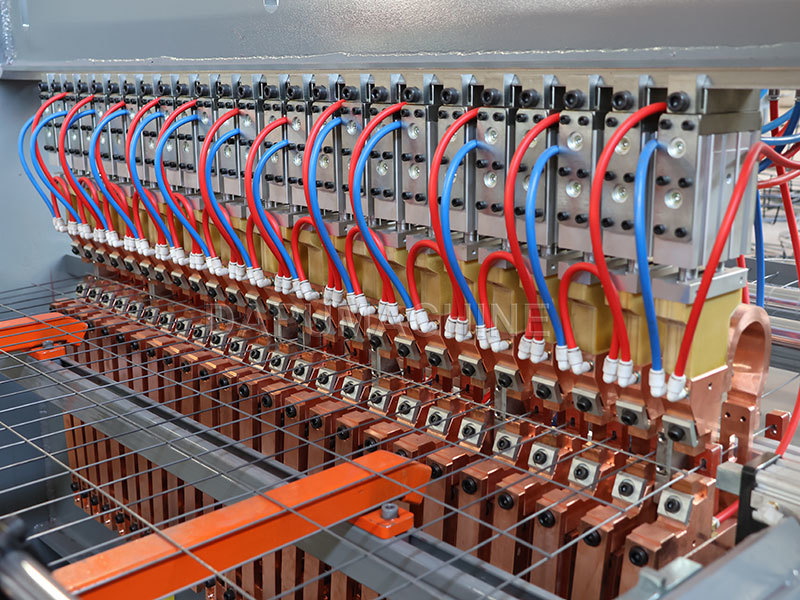
Welding speed directly affects production output. However, excessive speed without stable control may reduce weld quality and increase defective products.
High production efficiency requires a balance between speed and welding stability.
Modern mesh welding machines improve high-speed production through:
- PLC control systems
- servo motor feeding
- stable transformer output
- precise welding parameter adjustment
Stable welding performance reduces rework and improves overall production efficiency.
3. Reduce Machine Downtime

Machine downtime is one of the biggest factors reducing actual production efficiency.
Even high-speed machines may experience low real output if production interruptions occur frequently.
Common causes of downtime include:
- electrode replacement
- overheating
- unstable electrical systems
- maintenance issues
- component wear
Factories can reduce downtime through:
- preventive maintenance
- regular inspection
- stable cooling systems
- high-quality machine components
Reducing unexpected stoppages helps maintain stable continuous production.
4. Improve Pneumatic and Electrical Stability

Stable pneumatic and electrical systems are essential for efficient welding production.
Unstable welding pressure or fluctuating current may cause:
- weak weld joints
- inconsistent mesh quality
- increased defects
- production interruptions
Modern mesh welding machines improve stability through:
- independent welding control systems
- stable pneumatic structures
- reliable welding transformers
- optimized copper conductivity systems
Consistent welding performance helps factories maintain high production efficiency and reduce material waste.
5. Use Efficient Cooling Systems

Heat management is critical in continuous mesh welding production.
Without proper cooling, electrodes and transformers may overheat, reducing machine stability and production speed.
Modern machines commonly use:
- water-cooled welding electrodes
- water-cooled transformers
- optimized cooling circulation systems
Efficient cooling systems help:
- maintain stable welding quality
- extend electrode life
- support continuous high-speed production
Stable temperature control is essential for long-term production efficiency.
6. Improve Operator Efficiency
Operator experience also affects production efficiency.
Improper operation may increase:
- setup time
- machine adjustment time
- maintenance delays
- production errors
Factories can improve operator efficiency through:
- operator training
- touch screen PLC systems
- simplified machine controls
- standardized production procedures
Modern control systems allow operators to quickly adjust welding parameters and reduce manual operation errors.
7. Optimize Production Scheduling and Batch Production
Efficient production management is another important factor in improving factory output.
Frequent product changes may increase machine adjustment time and reduce effective production hours.
Batch production helps improve efficiency by:
- reducing changeover time
- improving material preparation
- minimizing machine idle time
- stabilizing production rhythm
Many factories also use takt time analysis to optimize production flow and improve delivery performance.
8. Monitor Machine Utilization Rate
Theoretical machine speed is not equal to actual production output.
Actual efficiency depends heavily on machine utilization rate.
Factors reducing utilization include:
- maintenance downtime
- material shortages
- unstable welding performance
- waiting time between production batches
Factories usually calculate effective production using utilization rates between 80% and 95%.
Improving utilization rate is one of the most effective ways to increase real production efficiency.
Industry Practices and Manufacturers

Today, improving production efficiency is a major focus for wire mesh welding machine manufacturers.
Some well-known manufacturers include Schlatter, EVG, Progress Group, Schnell, TJK Machinery, and Hebei DAPU Machinery. These companies continue to optimize automation systems, welding structures, and machine stability to help factories achieve higher productivity and lower operational costs.
Modern mesh welding production lines often combine servo motor systems, PLC control, automatic feeding systems, and stable pneumatic welding technology to improve efficiency and reduce downtime.
Future Trends in Mesh Welding Efficiency
The wire mesh industry is increasingly moving toward intelligent and automated manufacturing.
Future production trends include:
- intelligent PLC systems
- servo-driven automation
- energy-saving welding technology
- reduced labor dependence
- real-time production monitoring
Factories that invest in stable and automated production systems are more likely to improve competitiveness and long-term profitability.
Conclusion
Improving production efficiency in wire mesh welding requires more than simply increasing welding speed.
Automation level, machine stability, cooling systems, operator efficiency, and production management all play important roles in determining actual factory output.
By optimizing these factors, manufacturers can reduce downtime, improve weld quality, increase production capacity, and achieve more stable long-term production performance.
production efficiency,wire mesh welding machine
Relevant news
Contact Us
Email: sales@dapumachine.com
Mobile: +86-186-3215-1819
WhatsApp/Wechat: +86-186-3215-1819
Tel: +86-311-8605-2622
Add:Anping Industrial Zone, Hebei, China
