
Build a High-Yield Binding Wire Production Line: Core Equipment Recommendations for Consistent Quality & Profitability
Category: News
Add time: 2026-06-29
In the construction, packaging and hardware manufacturing sectors, demand for high-quality binding wire continues to rise — yet many producers struggle with inconsistent diameter tolerance, brittle wire finish, low throughput and rising energy costs. A well-configured binding wire production line does not only reduce scrap rates and labor input, but also delivers uniform ductility and surface quality that secures long-term client trust. Below we break down the three core pieces of DAPU equipment that form the backbone of a competitive binding wire manufacturing setup, and explain how each adds value to your process flow.
1. Straight Line Wire Drawing Machine: Heavy-Duty Rough Drawing for High Throughput
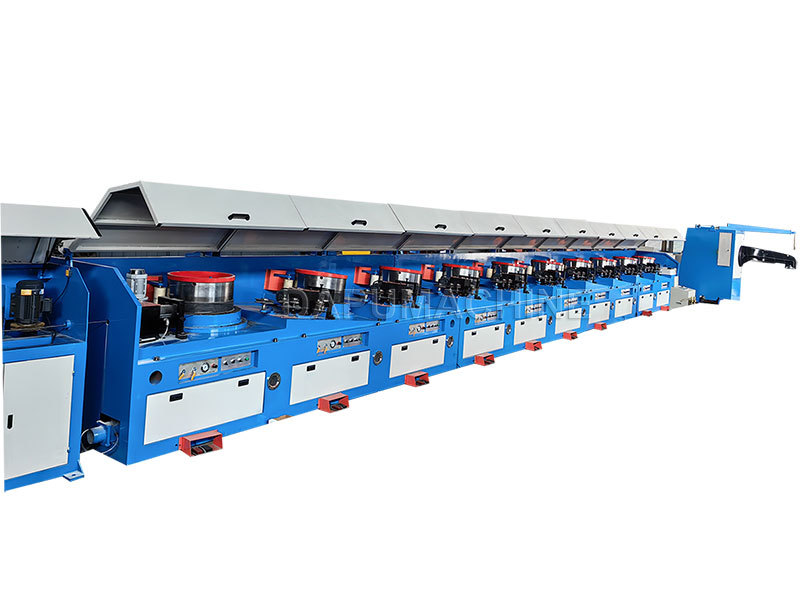
As the first stage of diameter reduction, DAPU straight line wire drawing machine handles raw wire rod (typically 5.5–6.5 mm low-carbon steel) down to intermediate diameters (2-2.5mm) efficiently. Its inline, twist-free drawing path ensures the wire undergoes minimal bending stress during multi-pass reduction, which preserves material toughness for downstream annealing and final use.
Why it is ideal for binding wire production:
1.High drawing speed & stable output: Equipped with AC frequency conversion control and precision tension sensors, it maintains consistent speed and wire tension across all capstans, boosting daily output significantly compared with pulley-type machines. For 2.2mm output wire, DAPU straight line wire drawing machine can bring you 1.2T/ hour production;
2.Superior cooling performance: Narrow-gap internal water cooling for capstans and direct water-cooled die boxes effectively dissipate friction heat, preventing overheating and surface oxidation even during continuous operation.
3.Low torsion, uniform quality: The straight wire path eliminates twisting defects, so the drawn wire has consistent roundness and mechanical properties — a critical foundation for subsequent fine drawing and annealing.
4.Flexible process adaptation: It supports random capstan skipping to match different reduction ratios, making it easy to switch between binding wire specifications.
Also you can produce different diameter wire for different application, such as nail, fence, welded mesh...etc; A single piece of equipment accommodates product diversity.
For producers targeting medium-to-large volume output, a straight line wire drawing machine is the most cost-effective choice for the rough drawing phase.
Reference Technical Parameters (for binding wire rough drawing)
Inlet wire diameter: φ5.5 – 6.5 mm low carbon steel wire rod
Outlet wire diameter: φ1.8 – 3.0 mm
Max. drawing speed: 10 – 12 m/s
Number of drawing passes: 5 – 9 (customizable)
Installed power: 22-37 kW
Typical 8-hour capacity: 8-9 metric tons
2. Water Tank Wet Wire Drawing Machine: Precision Fine Drawing for Smooth, Accurate Finish
After rough drawing, DAPU water tank (wet-type) wire drawing machine takes over for fine reduction — typically from 2.5/ 2.2/ 2.0 mm down to 0.6–1.2 mm, the common gauge range for binding wire. The entire drawing process runs immersed in lubricating coolant, which is the key to its premium surface finish and long die life.
Key advantages for binding wire manufacturing:
1.Excellent surface quality: Continuous coolant lubrication reduces friction between wire and dies, resulting in a smooth, scratch-free wire surface that performs well in subsequent bundling or galvanizing processes.
2.High dimensional accuracy: Multi-die step-by-step drawing with precise tension control delivers tight diameter tolerance, ensuring every coil of binding wire meets uniform gauge standards.
3.Extended die service life: Wet drawing conditions greatly reduce die wear, lowering consumable costs and reducing downtime for die replacement.
4.Compact footprint: Integrated tank and drawing head design saves floor space, making it suitable for both new production lines and capacity expansion of existing workshops.
For fine-gauge black annealed binding wire or galvanized binding wire, a water tank wire drawing machine is indispensable for achieving the required finish and dimensional precision.
Reference Technical Parameters (for standard binding wire fine drawing)
Inlet wire diameter: φ1.8 – 3.0 mm
Final wire diameter: φ0.6– 1.4 mm (covers mainstream construction & packaging binding wire gauges)
Max. drawing speed: 8-10m/s
Number of drawing passes: 9-11 (customizable)
Installed power: 30 – 45 kW
Typical 8-hour capacity: 1.2-1.8metric tons
3. Well-Type Annealing Furnace: Controlled Heat Treatment for Optimal Ductility
Binding wire must be soft, flexible and easy to twist by hand or rebar tying machines — and that is exactly what proper annealing delivers. DAPU well-type annealing furnace performs batch heat treatment on coiled drawn wire, relieving internal stress from cold drawing and adjusting hardness to the ideal level for binding applications.
What makes it a must-have for binding wire lines:
1.Uniform temperature, consistent hardness: High-efficiency air circulation systems ensure even heat distribution inside the furnace (±5°C temperature difference), so every coil in the batch achieves identical ductility and tensile strength.
2.Clean, bright wire surface: With protective atmosphere options, the furnace minimizes oxidation and decarburization, preserving wire surface quality without extra post-treatment polishing.
3.Energy-efficient design: Thickened insulation lining and optimized heat transfer structure reduce heat loss, cutting energy consumption per ton of product. Gas-heated models are also available for regions with unstable power supply.
4.Customizable capacity: Furnace size and loading capacity can be tailored to match your drawing line output, ensuring balanced production rhythm and no bottleneck in the heat treatment stage.
Precision annealing is the step that turns hard drawn wire into workable, user-friendly binding wire — and directly determines your product’s market competitiveness.
Reference Technical Parameters (matched for binding wire production)
Loading capacity: 3-4 metric tons per batch (single-well / dual-well configurations available)
Working temperature range: 500 – 800 ℃ (adjustable for low carbon steel stress relief annealing)
Temperature uniformity: ±5 ℃ across the furnace chamber
Typical full annealing cycle: 8-10 hours (heating + heat preservation + controlled cooling)
A Complete, Balanced Line for Sustainable Returns
When configured correctly, the straight line wire drawing machine (rough drawing) + water tank wire drawing machine (fine drawing) + annealing furnace (heat treatment) workflow creates a closed-loop binding wire production system with matched throughput, stable quality and controllable operating costs. Whether you produce black annealed binding wire for construction or supply galvanized binding wire for packaging, this equipment combination delivers the reliability and product consistency that build long-term customer loyalty.
If you are planning a new binding wire production line or upgrading your existing setup, we provide full process design, equipment matching and on-site commissioning support. Contact DAPU engineering team for a customized production solution tailored to your target output, wire specifications and site conditions. analyze operating costs and projected returns, and provide high-quality equipment and services to help you generate greater profitability.
Relevant news
Contact Us
Email: sales@dapumachine.com
Mobile: +86-186-3215-1819
WhatsApp/Wechat: +86-186-3215-1819
Tel: +86-311-8605-2622
Add:Anping Industrial Zone, Hebei, China
